


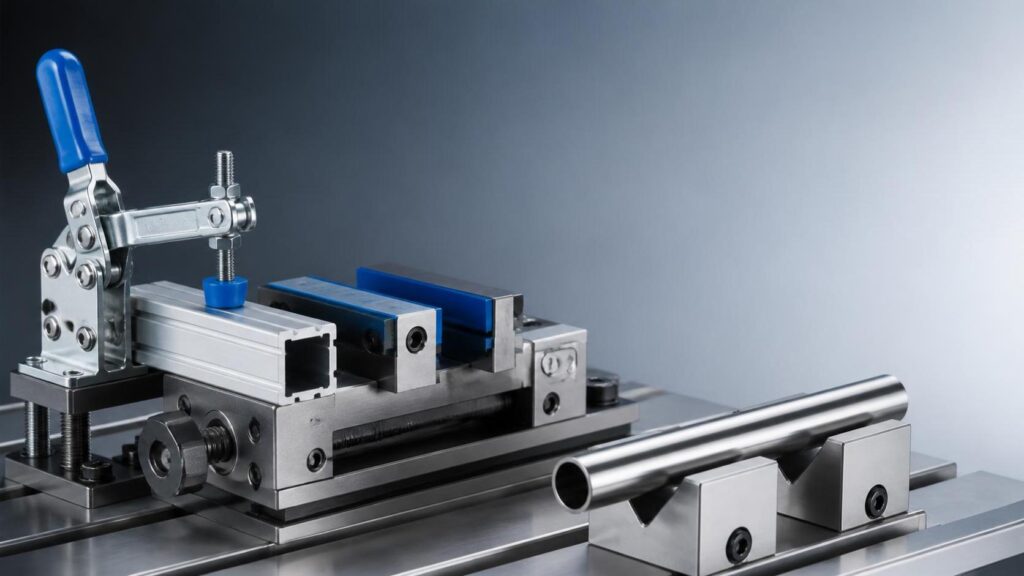

Choosing clamping tools that grip firmly without damaging the part
When surface finish matters, the wrong clamp can ruin a good part before machining even starts. This shows up all the time with polished stainless, anodized aluminum, thin-wall tubing, brass, and softer alloys that bruise easily. In those jobs, the best Clamping Tools are not simply the ones with the highest force. They are the ones that spread pressure, resist slip, and match the geometry of the workpiece.
A common mistake is assuming that tighter is safer. In practice, excessive point pressure is what leaves clamp marks, edge dents, and witness lines. If an operator has to over-tighten just to stop movement, the setup is usually wrong: contact area is too small, jaw material is too hard, or the holding direction is fighting the cutting force.
What usually works better
For flat or finished parts, toggle clamps with soft pads are often a good starting point. They give repeatable holding pressure and are easy to control in fixture work. If the pad is polyurethane, rubber-faced, or fitted with a replaceable plastic tip, the risk of marking drops noticeably compared with bare steel contact.
For milling vises and general bench work, machinists often rely on soft jaws rather than changing the whole clamp. Aluminum, brass, nylon, or urethane jaw covers can hold surprisingly well if the part is properly nested. The real benefit is not softness alone; it is conforming to the part shape so the load is shared over more area.
Round stock is where many marks happen. Standard flat jaws tend to create narrow contact lines, especially on tube and polished bar. V-blocks, strap clamps with protective liners, or collet-style holding usually treat these parts better. Collets are especially useful when concentricity matters and the outside surface must stay clean, though they are less flexible if part sizes change often.
Material matters as much as clamp style
Steel-on-steel contact may be acceptable on rough stock, but it is rarely the best choice for decorative or prefinished material. Soft contact pads help, yet they are not magic. If chips get trapped under a rubber pad, the pad itself can emboss the surface. On fine-finish work, keeping the clamping face clean is just as important as choosing a softer interface.
Thin parts also need a different mindset. A hard clamp may not leave a visible dent, but it can distort the part enough to affect machining accuracy. In those cases, vacuum fixtures, magnetic workholding for suitable ferrous materials, or custom nests with light top clamping are often better than brute-force mechanical pressure.
How to decide in the shop
A practical selection check is simple: look at part material, surface condition, shape, and cutting load together. If the operation is light and the finish is critical, prioritize broad contact and softer jaws. If cutting forces are higher, add positive location features so the clamp does not have to do all the work. That might mean stops, pockets, V-supports, or a dedicated fixture.
If marks are already showing up, changing clamp force alone is rarely the full fix. Check pad hardness, contact area, chip contamination, and whether the clamp is pushing the part sideways while tightening. Small setup changes often solve what looks like a tooling problem.
In most metalworking shops, the safest answer is not one universal clamp. It is a mix of clamping tools, soft interfaces, and part-specific support. Secure holding without surface marks usually comes from balance, not maximum pressure.