


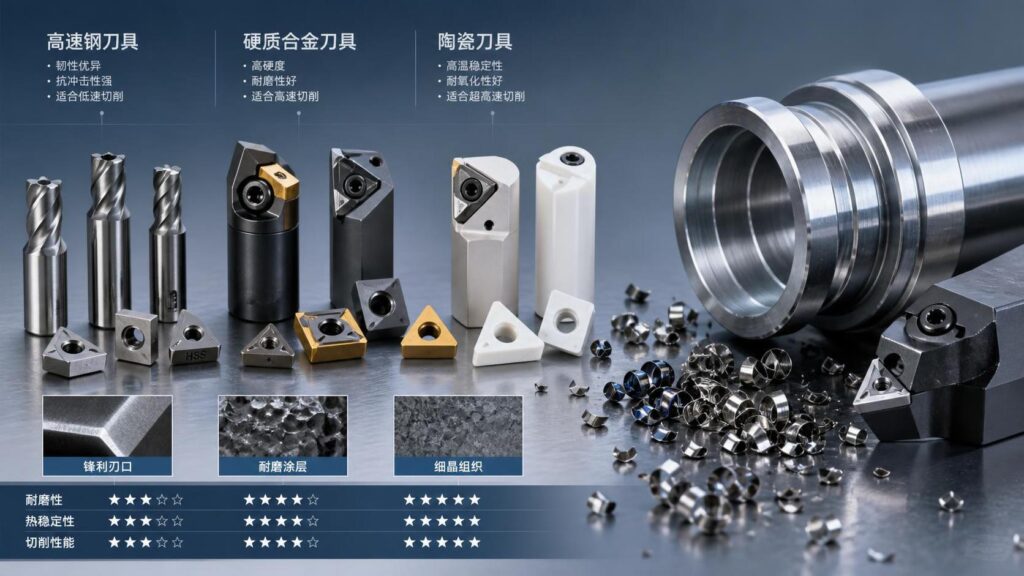

When evaluating Cutting Tools, blade material is often the factor that most directly affects cutting efficiency, wear resistance, service life, and total operating cost. For technical assessors, understanding how different materials perform under varying loads, speeds, and workpiece conditions is essential to making reliable procurement and application decisions. This article outlines the key blade material considerations that matter most when selecting tools for consistent industrial performance.
The most common mistake in tool selection is to treat blade material as a standalone quality indicator. In practice, no material is “best” in the abstract. What matters is the match between blade material, workpiece material, cutting parameters, machine rigidity, coolant strategy, and acceptable failure mode. A blade that performs exceptionally in stable, high-speed production may fail quickly in interrupted cuts or poorly controlled setups.
Hardness matters, but not without toughness
Blade material evaluation usually starts with hardness, because hardness is closely tied to wear resistance. Higher hardness generally helps a cutting edge resist abrasion and maintain geometry longer, especially when machining abrasive materials or running at elevated cutting speeds. This is why carbide and advanced ceramics are widely used in demanding industrial operations.
But hardness alone can mislead selection decisions. As hardness rises, brittleness often becomes a greater concern. In real production, technical teams are not only managing flank wear; they are also managing chipping, edge fracture, thermal shock, and instability caused by variable workholding or machine vibration. For interrupted cutting, heavy feeds, or less rigid equipment, a tougher blade material may outperform a harder one over the full operating cycle.
What different blade materials actually change in performance
High-speed steel (HSS) remains relevant where toughness and grindability matter more than maximum wear life. It is often suitable for lower-speed cutting, complex tool geometries, and applications where regrinding is part of the operating model. Its limitation is faster wear under heat and speed.
Cemented carbide is the industrial baseline for many metal cutting applications because it offers a practical balance of hardness, hot hardness, and productivity. Compared with HSS, carbide usually enables higher cutting speeds and longer service life, but it is more sensitive to impact and setup instability.
Cermet is often considered when surface finish and dimensional stability are priorities, particularly in finishing operations. However, it is less forgiving in unstable cutting conditions.
Ceramic and cubic boron nitride (CBN) become relevant in hardened materials, cast irons, and high-speed finishing environments. These materials can deliver strong performance where heat resistance is critical, but they require a controlled process window. They are not simply premium upgrades for every shop condition.
Diamond tools, especially for non-ferrous and highly abrasive materials, can offer outstanding wear resistance and surface quality. Their use is limited in ferrous applications because of chemical interaction at high temperature.
Thermal behavior is often the deciding factor
For technical assessors, thermal performance deserves more attention than list-price comparisons. A blade material’s ability to retain hardness at elevated temperature, resist thermal cracking, and dissipate or tolerate heat often determines whether higher cutting speeds are realistic. This is especially true in automated production lines where thermal accumulation changes edge behavior over time.
In many cases, premature tool failure is not caused by insufficient nominal hardness, but by poor thermal compatibility with the process. Dry cutting, minimum quantity lubrication, and aggressive cycle-time targets all make this more important.
Coating does not replace substrate selection
Another frequent error is to overvalue coating while underestimating the substrate. Coatings such as TiN, TiAlN, or AlCrN can improve wear resistance, oxidation resistance, and lubricity, but coating performance depends heavily on the blade material beneath it. A well-coated but poorly matched substrate will still fail early. For this reason, material selection should begin with substrate behavior, then move to coating optimization.
Selection should be based on failure mode, not catalog hierarchy
A reliable assessment starts by identifying how the current tool fails: gradual wear, built-up edge, edge chipping, thermal cracking, plastic deformation, or catastrophic breakage. Each failure mode points to a different material need. Abrasive wear may justify a harder material. Chipping may indicate the need for more toughness. Built-up edge may involve both substrate choice and edge preparation.
Blade material matters most when it is evaluated in context. For technical decision-making, the key question is not which material is the most advanced, but which one stays stable under the actual cutting conditions your process can sustain. That is usually where performance consistency and total cost are decided.